Choosing a FUE hair transplant training course is not like booking a medical conference.
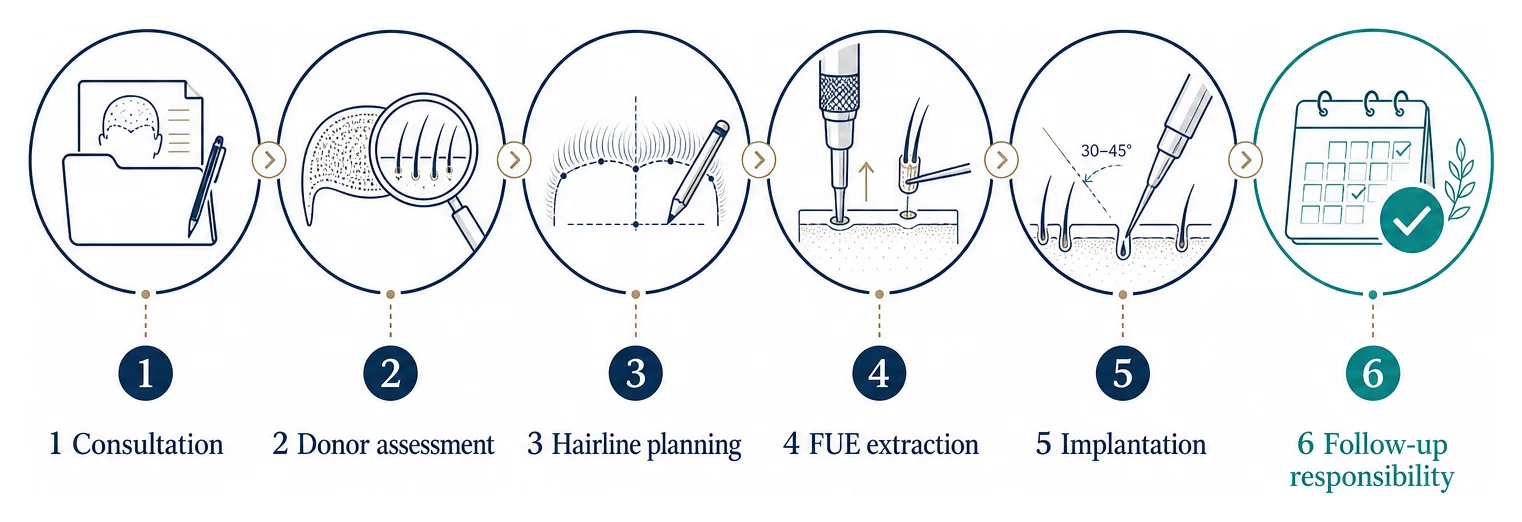
A conference can teach concepts. A lecture can show techniques. A video can explain the steps. But FUE hair transplantation is a surgical skill. It involves patient selection, donor management, hairline planning, tissue handling, extraction, implantation, post-operative care and long-term responsibility for the result.
For doctors, the question is not simply: Which course looks the best online?
The better question is:
Will this course help me understand the full clinical workflow of FUE hair transplantation, or will I mostly watch someone else operate?
This guide explains what doctors should check before choosing a FUE hair transplant training course.
1. Is the course designed for doctors?
The first thing to check is the target audience.
Some hair transplant courses are built for doctors. Others are mixed courses for doctors, nurses, technicians, assistants and clinic owners. That difference matters.
FUE is not only a technical extraction method. It is a medical procedure that requires diagnosis, planning, surgical judgement and responsibility for complications. Technicians and assistants can play an important role in a hair transplant team, but the medical decision-making belongs to the doctor.
A serious FUE course for doctors should cover more than the mechanical act of removing grafts. It should teach:
- patient consultation
- diagnosis and indication
- donor area assessment
- hairline design
- graft planning
- anaesthesia principles
- extraction technique
- graft handling
- implantation strategy
- post-operative care
- complication prevention
- realistic patient communication
If a course only teaches “how to punch grafts”, it is incomplete.
A doctor who wants to offer FUE safely needs to understand the whole case, not just one surgical step.
2. Is it observation-only or truly hands-on?
Many FUE courses advertise “hands-on training”. Doctors should look closely at what that means.
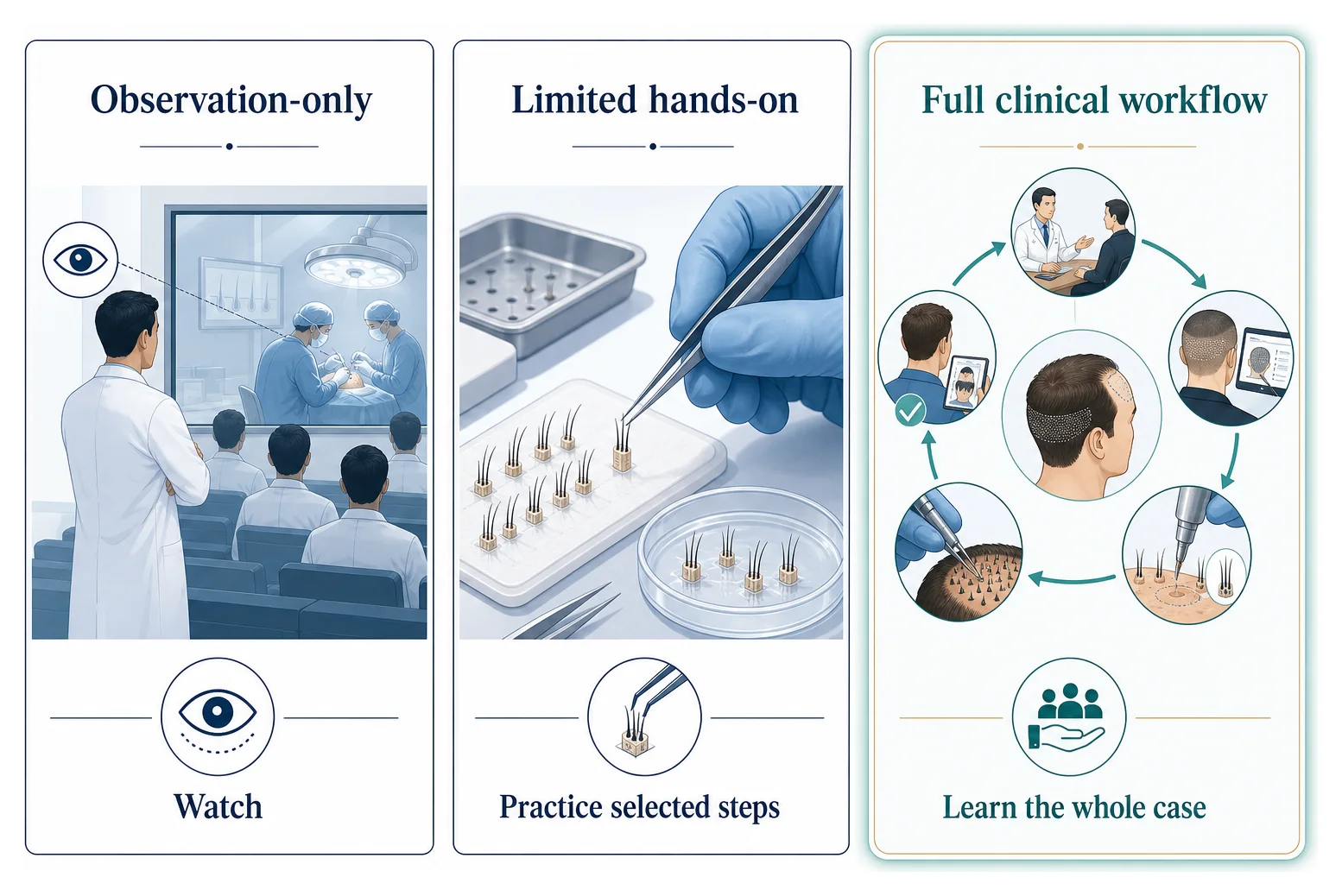
In some courses, hands-on means the participant holds an instrument for a few minutes. In others, it means performing a very limited number of grafts under supervision. Some programs are almost entirely observation-based, even if the marketing suggests otherwise.
Observation has value. Watching an experienced team work can help a doctor understand room setup, patient positioning, sequencing and communication. But watching is not the same as learning the surgical feel of FUE.
Before booking, ask the provider to explain:
- which parts are observation
- which parts are supervised practice
- whether real patients are involved
- how much practical exposure each doctor receives
- how many trainees share each case
- which steps the trainee may perform
- who supervises each step
Do not accept vague promises. “Hands-on” is not enough. Ask what you will actually do during the course.
3. Who is responsible for the patient after hands-on training?
This is one of the most important questions, and many doctors forget to ask it.
If trainees work on real patients, someone must remain responsible for the patient afterwards.
That is why many FUE training courses are watch-only. Others allow only a small practical component, often a limited number of grafts. This is understandable. Real patient training carries real medical responsibility. A training provider cannot simply let inexperienced doctors perform large parts of a procedure and then leave the patient with the consequences.
The real test of a hands-on FUE course is not how many grafts a trainee is allowed to touch. It is who remains responsible for the patient afterwards.
At HTTC, training takes place inside the clinical environment of HLC in Ankara. This makes a different model possible. The patient journey is managed as a complete medical process: consultation, donor assessment, planning, surgery, post-operative care and follow-up.
If a training case does not develop as expected, the patient is not left alone. HTTC/HLC remains responsible for the case and provides appropriate follow-up or corrective treatment at its own cost when needed.
This responsibility is what allows HTTC to offer a more complete hands-on FUE training pathway. Doctors do not only observe isolated steps. They learn how a real case is assessed, planned, performed and managed after surgery, while patient safety remains under the supervision of an experienced clinical team.
4. Does the course cover the full FUE workflow?
FUE training should not start and end in the operating room.
A good result begins before the first graft is removed. A poor plan cannot be rescued by good extraction technique. Doctors need to understand why a patient is accepted, rejected or treated conservatively.
A complete FUE course should include the full workflow.
Consultation and patient selection
Not every patient is a good candidate. Doctors should learn how to evaluate age, hair loss pattern, donor capacity, expectations, medication history and future hair loss risk.
Donor management
The donor area is limited. Overharvesting is one of the most serious mistakes in hair transplantation. Training should explain safe extraction patterns, density assessment and long-term donor preservation.
Hairline planning
A natural hairline is not just a line on the forehead. It depends on age, facial structure, hair characteristics, density, future loss and patient expectations.
Extraction
Doctors should learn punch control, depth, angle, spacing, graft quality and how to reduce transection risk.
Graft handling
Grafts are living tissue. Poor handling, dehydration, crushing or excessive time outside the body can affect survival.
Implantation strategy
The course should explain density, direction, angle, distribution and how to create a natural result.
Post-operative care
Patients need clear instructions after surgery. Doctors should understand washing, swelling, crusting, shock loss, infection signs and follow-up timing.
If a course skips these areas, it is not teaching FUE as a medical procedure. It is teaching fragments.
5. How many trainees are in the room?
Group size matters.
A crowded workshop may look impressive in photos, but it often means less time at the surgical field. In FUE training, every participant wants access to the same thing: the patient, the trainer and the live surgical details.
Before booking, doctors should ask:
- How many doctors attend each course?
- How many trainers supervise the group?
- How many live cases are available?
- Will every doctor receive individual feedback?
- Will I be able to ask case-specific questions?
- How much practical exposure is realistic?
Small groups or tailored training formats usually allow better supervision. Large groups may be useful for lectures, but they are weaker for surgical learning.
FUE is learned through detail. If the trainer cannot see your hand position, punch angle, extraction pattern or tissue handling, they cannot correct you properly.
6. Who supervises the training?
The person supervising the course matters more than the person featured in the brochure.
A good FUE trainer should not only be experienced. They should also be able to teach. Those are different skills.
Doctors should check whether the training is supervised by surgeons who:
- perform FUE regularly
- understand donor management
- can explain mistakes clearly
- teach both planning and execution
- show complication prevention
- give practical feedback
- work in a real clinical environment
At HTTC, doctors train in the clinical environment of HLC Ankara with HLC surgeons who have more than 20 years of experience in FUE hair transplantation and professional involvement in international hair restoration organisations such as ISHRS, FUE Europe and other recognised societies.
This matters because FUE is not learned from theory alone. Doctors need to see how experienced surgeons think during real cases: when they slow down, when they change plan, when they reject a graft, when they protect the donor area and when they tell a patient that less is safer.
7. Are professional instruments and tools used?
The quality of the instruments affects the training experience.
A good tool does not make someone a good surgeon. But poor instruments can make good technique harder to learn.
Doctors should ask which tools are used during the course and whether the training includes explanation of:
- punch types
- punch size selection
- manual and motorised extraction concepts
- graft handling forceps
- implantation tools
- device limitations
- maintenance and sterilisation
- common beginner mistakes with instruments
HTTC works with Dr. John Cole and Cole Instruments as an instrument and technology partner. Cole Instruments is known for high-quality tools in modern hair transplantation, including advanced FUE punches and implantation systems.
For doctors learning FUE, this is relevant. Technique and instruments are linked. The course should not only show the tool, but explain when to use it, how to control it, and where beginners commonly damage grafts or tissue.
8. Does the course teach complications and ethics?
A weak course shows perfect cases.
A serious course teaches what can go wrong.
Doctors should expect a FUE training program to discuss complications and risk management, including:
- overharvesting
- poor graft survival
- visible donor depletion
- unnatural hairline design
- poor angulation
- infection risk
- necrosis risk
- shock loss
- poor patient selection
- unrealistic promises
- repair cases
- emotional and psychological expectations
Ethics should also be part of training. Hair transplantation is an elective procedure, but it has long-term consequences. A young patient with aggressive hair loss may need a very different plan than an older patient with stable loss. A dense frontal result today can become a problem if the donor area is not managed for the future.
Doctors should avoid any course that presents FUE as an easy business add-on without discussing responsibility.
Hair restoration is not only about creating growth. It is about protecting the patient from bad decisions.
9. What does the certificate actually mean?
Many courses offer a certificate. That can be useful, but doctors should understand what it does and does not mean.
A certificate of participation or completion can document that a doctor attended a course and was exposed to specific training modules. It may be helpful for professional records, internal documentation or clinic development.
But a course certificate is not the same as a medical licence. It does not automatically authorise a doctor to perform hair transplantation in every country. Local laws, licensing rules and professional regulations still apply.
Doctors should ask:
- What type of certificate is issued?
- What does it state exactly?
- Does it document course duration and content?
- Does it claim more than it should?
- Is the course transparent about legal limitations?
A serious provider will not exaggerate the meaning of a certificate. It will explain that training is part of professional development, not a replacement for local medical regulation.
10. What support exists after the course?
FUE learning does not end on the last day of training.
The first real challenge often comes later, when the doctor returns to their own clinic and begins evaluating patients, setting up instruments, training staff and deciding which cases to accept.
Doctors should ask whether the course offers:
- post-course questions
- advanced training options
- case discussion opportunities
- support for clinic setup
- protocols or checklists
- guidance for assistants or technicians
- the possibility to return for further training
No short course can make a beginner fully independent overnight. A responsible course should be honest about that.
The goal of initial FUE training is to build a foundation: understanding the workflow, learning the risks, practising under supervision and knowing what further experience is needed.
Doctor’s checklist before booking a FUE course
Before choosing a FUE hair transplant training course, ask these questions:
- Is the course specifically designed for doctors?
- Is it mostly observation, or is there supervised hands-on training?
- Are real patients involved?
- If trainees work on real patients, who remains responsible for the patient afterwards?
- Does the course cover consultation, planning, surgery and post-operative care?
- How many trainees attend each course?
- Who supervises the training?
- Are the trainers active FUE surgeons?
- Does the course teach donor management and hairline design?
- Does it include complication prevention?
- Which instruments and tools are used?
- Is the certificate clearly explained?
- What support exists after the course?
- Are the costs and logistics transparent?
- Will the course help you understand FUE as a complete medical workflow?
If a provider cannot answer these questions clearly, be careful.
A doctor should not choose a FUE course based only on price, location or marketing photos. The more important question is whether the course gives real clinical understanding while protecting the patient.
Why doctors choose HTTC in Ankara for FUE training
HTTC is designed for doctors who want to understand FUE as a complete medical workflow, not as a short technical demonstration.
Training takes place inside the HLC clinical environment in Ankara. Doctors are exposed to the full patient pathway: consultation, planning, surgery, post-operative care and follow-up. This is different from courses where participants mainly observe or perform only a very limited number of grafts.
The key difference is responsibility. When real patients are involved, HTTC/HLC remains responsible for the case. If a training case does not develop as expected, appropriate follow-up or corrective treatment can be provided at HTTC/HLC’s own cost when needed.
This model protects the patient and gives doctors a deeper learning experience.
HTTC also combines the clinical experience of HLC surgeons with more than 20 years of FUE hair transplantation experience, international professional involvement through organisations such as ISHRS and FUE Europe, and instrument support from Dr. John Cole and Cole Instruments.
For doctors, this creates a practical training environment where technique, planning, tools, ethics and follow-up are connected.
That is what FUE training should be.
FAQ
Can any doctor learn FUE hair transplantation?
Doctors from different medical backgrounds may train in FUE, depending on their local regulations, surgical experience and professional scope. Dermatologists, plastic surgeons, aesthetic doctors and other physicians may be interested in FUE training. Each doctor must check the legal requirements in their own country before offering hair transplantation.
Is a short FUE course enough to start operating independently?
A short course can provide a foundation, but it should not be seen as the end of training. FUE requires practice, supervision, case selection skills and long-term judgement. Doctors should start carefully, choose suitable cases and continue learning after the course.
What is the difference between observation and hands-on FUE training?
Observation means watching an experienced team perform the procedure. Hands-on training means the participant performs selected steps under supervision. Many courses combine both, but the amount of real hands-on exposure can vary greatly.
Why are many FUE courses watch-only?
Because working on real patients carries medical responsibility. Some providers limit trainee involvement to protect the patient and avoid responsibility for the final result. This is why doctors should ask who remains responsible for the patient after a training case.
What makes HTTC different from typical FUE workshops?
HTTC training takes place inside the HLC clinical environment in Ankara. The patient journey includes consultation, planning, surgery and follow-up. If a training case does not develop as expected, HTTC/HLC remains responsible and can provide appropriate follow-up or corrective treatment at its own cost when needed.
Do I receive a certificate after FUE training?
Most professional courses provide a certificate of participation or completion. Doctors should understand that such certificates document training exposure but do not replace local medical licensing or legal requirements.
Are real patients involved in FUE training?
Some courses use real patients, while others are observation-based or use simulation. Real patient training can offer deeper learning, but only if strict supervision and follow-up responsibility are in place.
What should I check before choosing a FUE course?
Check whether the course is for doctors, whether it is hands-on or observation-only, who supervises the training, how many trainees attend, which parts of the workflow are covered, what tools are used, how complications are taught and who remains responsible for the patient after the procedure.
Is Turkey a good place for FUE hair transplant training?
Turkey has a large hair transplantation market and extensive clinical exposure. For doctors, this can be valuable if the course is medically structured, supervised by experienced surgeons and focused on patient safety rather than only volume.
How can I apply for HTTC FUE training?
Doctors interested in HTTC training can contact the team to discuss their current experience level, preferred training dates and whether a beginner or advanced FUE course is the right fit.